
The nature of customer expectations has been completely turned around by the advent of the digital age. Modern consumers are now expecting an interactive, realistic, and personalized experience, especially when evaluating a product or service offering.
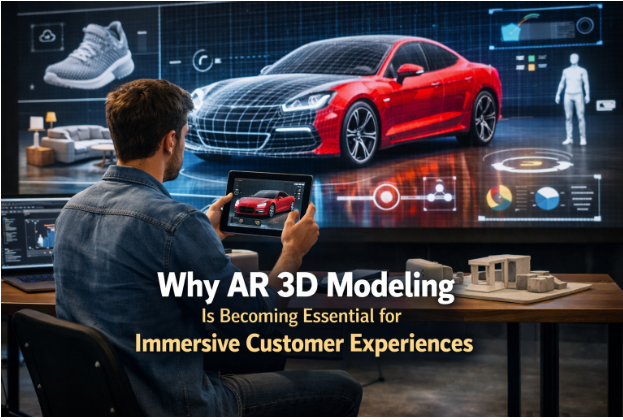
Since static images and videos are finding it tough to deliver this experience, a new technology has been developed in the form of AR 3D modeling. This technology offers a realistic setting with a lot of detail in 3D, which lets consumers see a product as if it were right in front of their eyes.
Reliable AR experiences rely heavily on the precision, expertise, and professionalism brought about by 3D modeling. The look, size, and design of 3D models are what make it a successful experience in reality. All of these are revolutionizing the way businesses communicate, market, and engage with their consumers.
Some of the most prominent factors that display how 3D modeling in augmented reality has become a necessity to provide consumers with immersive experiences are as follows:
1. Product Translation to Real-World Environments
One of the most common issues that consumers face when it comes to doing online shopping has to do with their inability to feel, touch, and experience a product in a certain setting. This has been solved by using AR 3D Modeling, which provides a customer with the opportunity to experience a product in their own setting.
This live placement feature benefits users in understanding:
- Product size measurement and scaling
- How it relates to their space
Whether these colors and styles complement other decorations present in that particular space and match the usefulness in a practical and real-world setting.
A level of visualization that has this much relation with context offers an experience that is extremely immersive and comforting compared with that of normal online browsing.
2. Offering Intuitive 360-degree Product Interaction
Static images cannot be compared in terms of the control consumers are able to exercise when using dynamic product exploration. Using AR models, consumers are able to rotate, zoom, and view products from all angles.
This interactive freedom of choice offers users the opportunities to examine:
- Handiwork and Textures
- Hidden components and features
- Functional mechanisms
- Material finishes and detailing
Such realistic and explorable visualizations are ensured by professional 3D modeling assistance. These features lead to improved customer understanding and trust.
3. Reducing Uncertainty and Increasing Buying Confidence
One of the reasons that keeps many people from acquiring goods from online marketplaces has to do with a lack of certainty. “Will it look the same in person?” “Will it fit right?” “Will it be the right color?” These are all questions that are answered with augmented reality including:
- Reducing product misunderstandings
- Increased customer satisfaction
- Reduces return rates
- Quick purchasing decisions
This means that when consumers are confident about their purchase decisions, their experience will also be enhanced.
4. Greater Emotional Investment Through Immersive Storytelling
This experience of AR provides a certain level of immersion that involves a customer’s emotional connection with a product. Whether it be a customer immersing themselves in a sofa in their own house, or visualizing a new product in their kitchen, this technology provides a personal space for their product.
Also, immersive storytelling would benefit immensely from 3D assets that are realistic and modeled by professional 3D asset companies.
5. Encouraging Customization and Personalized Engagement
Customers are also expecting personalized experiences. This experience with personalization using AR technology becomes possible as it provides users with the flexibility of changing different parameters of a product, say colors, sizes, and other configurations.
Interactive customization assists users in researching alternative options such as:
- Furniture finishes
- Fashion Trends
- Fashion
- Electronics configurations
- Car colors and specs
This creates a sense of ownership in the customer.
6. Increasing Brand Credibility with Innovation
This means that through the application of AR, a brand demonstrates innovation in its quest to satisfy its consumers. Offering consumers an immersive experience through AR technology sends a message that a certain brand promotes transparency, which means investing in technology that assists in informed decision-making for consumers.
This implies that:
- Enhanced brand perception
- Increased trust and authenticity
- Enhanced engagement with online channels
With 3D modeling solutions, it can be ensured that a product has a technologically advanced appearance, which would help brands present their products with confidence.
7. Development of Intuition and Engagement in Product Education
Applying AR technology extends beyond product exploration as it can also serve as a powerful explanation of features, assembly, and usage processes. Using AR overlays, companies provide consumers with a step-by-step guide.
This promotes:
- User understanding
- Product usability
- Customer onboarding
- Long-term satisfaction
Complex products are much easier to understand when consumers can experience those products in augmented reality environments.
8. Creating a Noteworthy and Competitive Customer Experience
With more brands competing for their attention, offering a memorable customer experience has become even more important. This, as a matter of fact, is where 3D modeling with the help of AR technology can help brands offer a memorable customer experience.
Such nostalgic experiences lead to:
- Higher Conversion Rates
- Increase repeat visits
- Organic sharing
In AR, consumers are given reasons to linger, to look around, and to return with immersive experiences.
Conclusion
AR 3D modeling has also become an important functional area in contemporary interactive experiences. With the help of interactive technology, along with the accuracy of high-quality 3D modeling services, businesses are able to create a journey for their consumers, which, in turn, not only creates trust but also promotes informed decision-making.
With advancements in immersive technology, product visualization using AR will become even more integrated in the future, as it has a huge impact on how brands engage with their audience in a world where technology reigns supreme.